The Relational Atlas · Facet five · Money and mutual credit
What you put in, written down.
A contributor who puts real work into a shared project puts it in one sentence: ARC matters to me because what I put in is written down when I put it in, not argued about later. This page cashes that sentence on the first credit the record carries. It is one entry, for one piece of real work, in a ledger that says SIMULATION on its own face, because no live arc account exists yet. The page prints that word wherever the ledger appears, at full size. A rehearsal, honestly labeled, is worth more than a market that only exists in a pitch, so the rehearsal is what is shown here, link by link, with its one honest gap printed as large as its facts. The work is credited. It is not yet priced. And the record itself explains why.
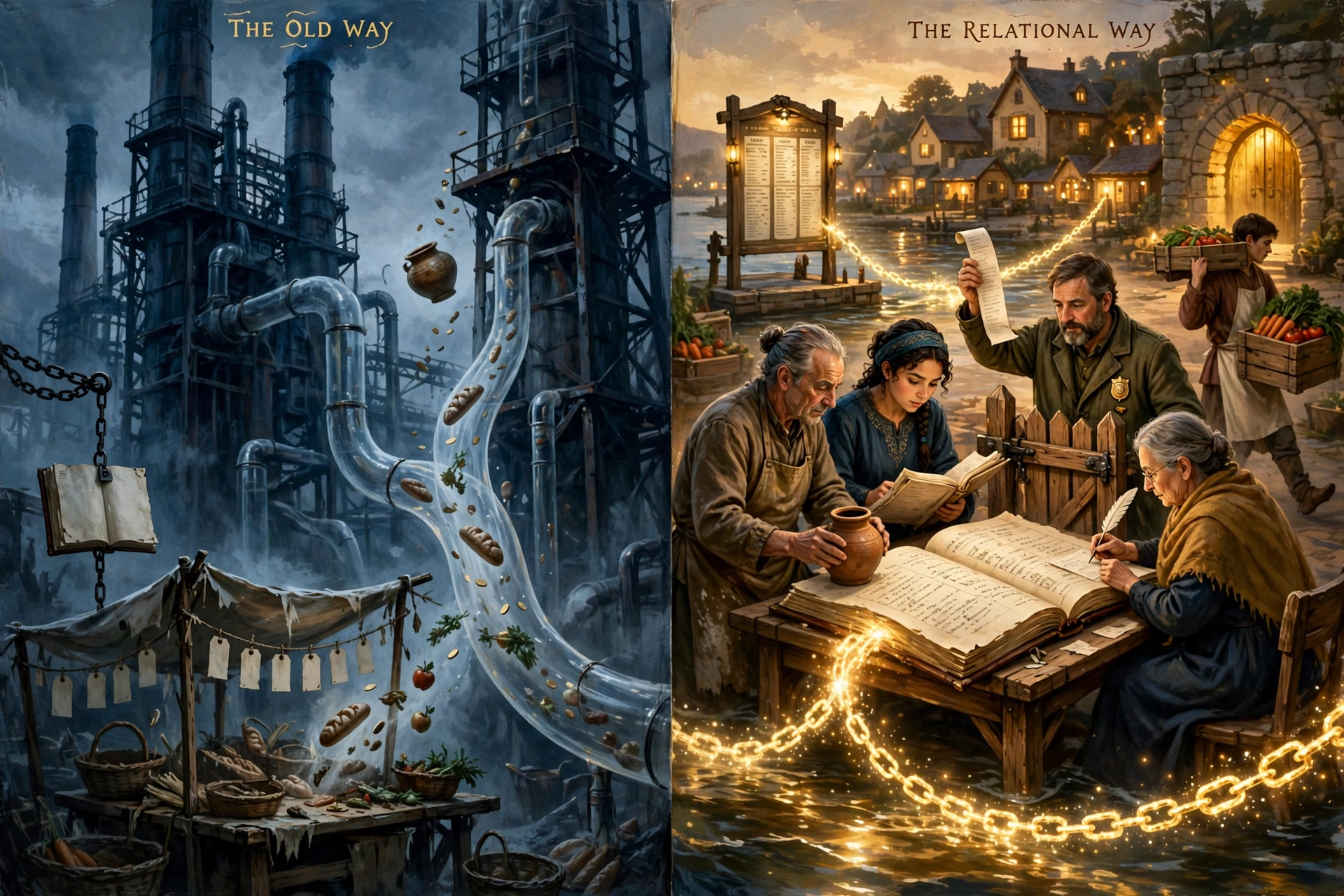
Written down when it happens
A contribution enters the record on the day it lands, linked to the work itself. Nobody reconstructs it later from memory, from chat threads, or from a spreadsheet one person happened to keep.
Credit nobody takes on faith
The ledger is a chain. Each entry carries the fingerprint of the one before it, so any reader can recompute the whole book and catch a changed line. Credit is arithmetic, not assertion.
The rules printed before they apply
The schedule states its prices, splits, and caps in the open, before any of them are used. And where the schedule holds no price for a kind of work, the record says exactly that, at full size, instead of inventing a number.
Pause, revoke, evidence
When settlement moves, it moves between people holding their own keys, under terms settled first. Every movement can be paused, can be revoked, and can be produced afterward as evidence.
Neighbours hold the same book
Mutual credit is two people looking at one ledger and seeing the same entries, the same history, and the same rules. No platform stands between them holding the only copy.
One. the first credit on the record Live in labeled simulation
The instance is contribution-001, the first entry in the foundation simulation credit ledger, recorded on October 22, 2026, the day the work it credits went live. The contributor is Marcus Yarbrough, the artist of facet one and the operator of Node 005. The work is the illustration at the head of this network’s homepage, the campaign’s face, drawn from his own one-pager and standing in live production use. Walk the chain the way the record carries it.
Link one. the work itself
He drew the one-pager himself, the two panels, extraction towers against the sovereign home, and it was received and filed on October 22, 2026 as the style standard of record. The rendition prepared from it was approved at 1792 by 1184 pixels, and the shipped WebP stands at the head of the homepage, byte-identical as served. Three receipted deployments carried the work and its credit live.
original dd49aa02d55443d11c7c061dc9826b1a6df016b12822516efd0d76ea29ec54da
rendition c449b4c34f9137b714e71a92e1f35e10d6b784fc0092125eb2af877ca0b11bd0
shipped 649cf5d5107be131afbd43147ad7770275d3998168153decbb1ee92e2fee4910
deployments 6ca8fe03-4637-474f-94b7-b75e537c1125 · 6049187a-d2e5-42b6-bb64-2b414d989534 · recognition 54dd03a2-a844-4cdd-80be-9f8d0ff5172b
How to check this link. Start at his card on the registry, where the chain stands link by link, and recompute the shipped image’s fingerprint from the homepage itself. Facet one, the creators page, walks this same chain in full.
Link two. the entry in the book
The entry stands at sequence 0, the first in the chain, its predecessor named genesis. It names the contributor, his node, and his record address. It records the contribution’s class in the founder’s words, artwork in live production use by the network, and the date, October 22, 2026. And it carries its own label on its face, printed here in its own words and at full size.
SIMULATION. A Schedule v0.3 credit recorded in the closed simulation only. No live arc account exists, no arc price exists, and this entry moves nothing.
contributor Marcus Yarbrough · Node 005 · arc:e67630fdeee1026bed9655bb521a97746af32c93c42488c699736e81bd8a8b1d
entry hash 5b913f0aa94662ffcf0db605b6297d451696496c6d34674a1969ed3b2fe92dcb
How to check this link. The entry’s hash is the SHA-256 of its canonical form, its fields in sorted order as compact JSON, with the previous entry’s hash carried inside it, so the book either recomputes or it does not. When this page was staged, the staging run recomputed the hash from the ledger file and it held, and checked the schedule file the entry names against the digest the entry records for it, and that matched too.
The ledger holds exactly one entry.
Link three. the two surfaces that carry it
The production surface names him at the work itself. The caption under the homepage hero reads, in its own words: Original artwork by Marcus Yarbrough. This rendition was prepared by Noetica from his original, and stands on the homepage with his credit. The member surface is his registry card, which carries a Contributions of record entry naming the class, the date, where the work lives in production, and this ledger entry. The ledger and the card name each other, so the walk runs in both directions.
Where the economics stand. The schedule this entry was recorded under, and the simulation it stands in, are stated on the Economics page at the same strength as here. Nothing on that page upgrades this entry either. It stands in simulation, and says so.
Two. not yet priced, and the record says why
The schedule does price a neighbouring class. Schedule v0.3 prices a developer artifact published at 15 arc, and its specification defines that class in so many words: a developer lists an application or tool under its own signature, with the artifact’s content digest recorded and the listing record as the evidence. The 15 arc figure is a price inside the same simulation schedule, stated here with its label attached: SIMULATION, no live arc account exists, and the figure buys nothing today.
Marcus’s contribution is original artwork that the network rendered from his original and placed in live production use. It is not an application or tool listed by a developer under its own signature, so the priced class as defined does not reach it. The entry therefore records the contribution with its class and no figure, priced set to false, amount empty, and its reasoning written into the entry itself rather than left in a meeting note.
The determination, as recorded
The entry’s own determination, in its substance: the class as defined does not price this contribution. No figure is recorded and no number is invented. Pricing the artwork in live production class is an open choice for the founder, named in the contribution recognition flow of October 22, 2026.
Where this stands. The record declines to stretch a definition to reach a number, and prints its refusal where the number would go. That refusal is part of the recognition, not an apology under it. A ledger that will invent a price for work it cannot price will invent anything, and this book is built to be checked by strangers. The open choice stands undecided, with its options on the record: extend the priced definition beyond developer applications and tools, add a priced class for creative work in production use, or hold the class unpriced. Until a ruling, entries record the class with no figure.
Three. where the claim stops
The ledger this page walks is a rehearsal, and the page has now said so on its grade, on the entry, and here, because a visitor who mistakes a rehearsal for a market has been failed by the page. The machinery being rehearsed is the real machinery: the chained entries, the named classes, the published schedule, and the settlement lifecycle the schedule’s disbursement rule already states, proposal, settlement, release, execution, evidence, receipt. What does not exist yet is the live account it would settle into, and the entry says that in its own settlement bound, in its own words: credited in the record now, in simulation; live settlement is a later phase behind its gates; the outward exchange bridge remains deferred under a separate governed act, and no live arc account exists.
Open choices that touch this facet
The contribution recognition flow carries five open choices for the founder’s word. Three of them touch this facet, and this page names them without resolving any of them in its copy. The first is pricing the artwork in live production class, standing in section two above. The second is recognition of contributors who hold no node: the member surface in the flow is a node card, so a contributor with no node has no surface yet, and whether the flow admits them, and where, is open. The third is the member surface’s shape: recognition stands per node on registry cards as built, and a single gathered contributions page is an alternative shape the site could carry, with which surface is canonical undecided. The remaining two choices belong to the artists facet’s walk. All five stand open.
What raises this facet. The catalogue names the act: the first live settlement, one real payment between two nodes against a recorded contribution. When it happens, it upgrades this existing page from live in labeled simulation to live. It does not launch a new claim, and this page will not borrow the upgrade early.
The extent, in one visit
Facet five of the Relational Atlas. Facet one showed a work of art carrying its own proof. This facet shows the credit for that work standing in a book anyone can recompute: written down the day the work landed, chained to the entry before it and the work behind it, labeled SIMULATION at full size because honesty about a rehearsal is what makes the rehearsal worth anything, and unpriced for a reason the record prints where the price would go. The pattern is the one every facet wears. Consent before use. Credit by construction. Provenance anyone can check. Governed agents, local nodes, and receipts. Here the clothes are a contributor’s, and the fit is checkable.
Written down when it happens. Checkable by anyone. Yours.