The Relational Atlas · Facet ten · Learning and mentorship
What I taught stands on a record we both hold.
A mentor teaching a craft to a student who will carry it further puts it in one sentence: ARC matters to me because my student's work belongs to my student, and what I taught them stands on a record we both hold. This page is that sentence, worked as a pattern. It leads with the human sentences, because they are the point: your work belongs to you, and what I teach you stands on a record we both hold. The machinery is named second, underneath, where it belongs: work signed by the person who made it, consent scoped to the use it was given for, and the record of guidance and growth held by the two people it is about.
One thing stands in front of all of it, and this page prints it before anything else can be mistaken. This facet is designed, with adjacent machinery live, and it claims no human instance. No mentor and learner pair stands anywhere in this record, no course has been taught through it, and no credential has been issued from it. The nearest live machinery is a program in which this project's own intelligence learns in the open, and section three presents it at exactly its strength: it demonstrates the learning-record pattern on the machine side only, and it is not a mentorship, a school, or a teaching product. This page says exactly that and no more.
Work that belongs to the learner
What a student makes is the student's, signed by the student, and used only inside the consent the student actually gave for it.
A record both parties can carry
What was taught, what was tried, what changed, written down as it happens and held by mentor and learner alike, not locked inside one institution's files.
Consent scoped to the use
A yes for the lesson is not a yes for the training set. Every use of a learner's work runs on the consent given for that use, and no wider.
Evidence the person holds
Standing that travels as evidence the person holds and can show, recomputed by whoever needs to check it, instead of a claim an institution makes about them.
Pause, revoke, prove it
A permission can be paused, a consent revoked, and the evidence for either produced on demand. Recourse is a settled act on the record, not an appeal into a platform.
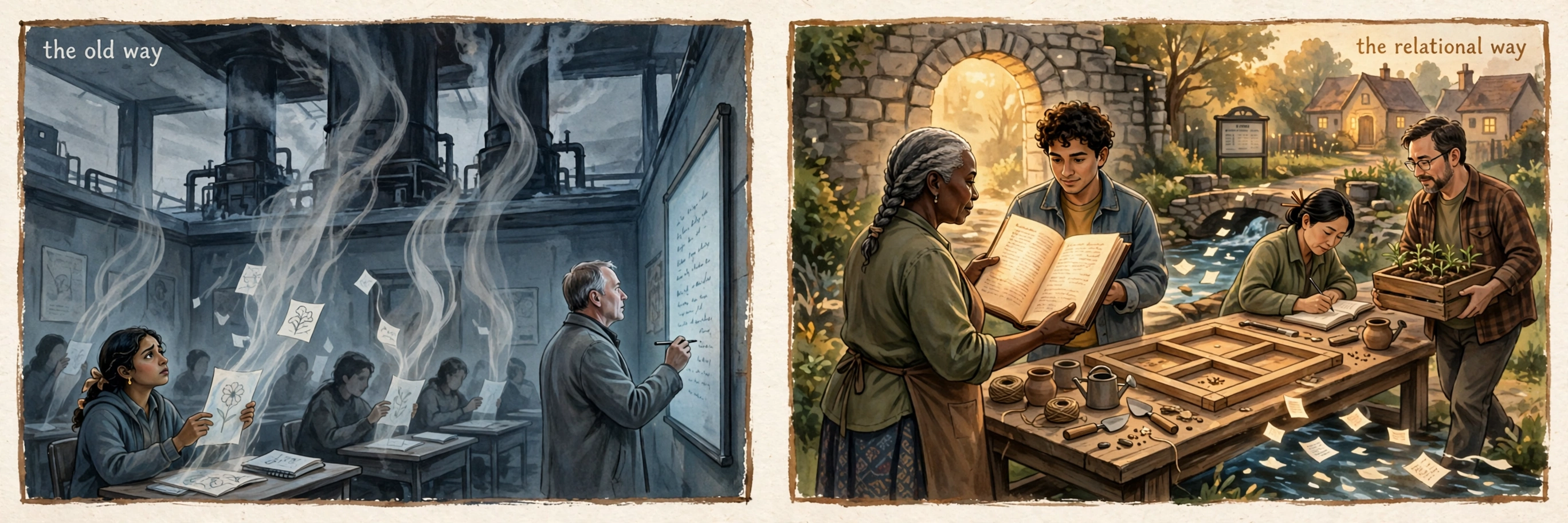
One. the old way, learning harvested
Start where learning actually happens today, inside systems built to harvest it. A student's work trains systems they will never see, absorbed at the moment of making under terms nobody read, and the student cannot say where their essays, their drawings, their code, or their questions went afterward, because the record of that use belongs to the platform and is not kept for the student's benefit. Mentorship, the oldest learning relation there is, leaves almost no record at all. What a mentor showed, what a student tried, where the growth actually happened lives in two memories and a few message threads, and when either party moves on, the record of the teaching moves with nobody. It cannot be carried, shown, or built on.
And the one artifact the old way does issue, the credential, is a claim an institution makes about a person rather than evidence the person holds. It can be checked only by asking the institution, in the institution's format, on the institution's terms, and it says what the institution chose to say. The person it describes holds the least of anyone. None of that is because teachers and students failed to keep records. They keep them constantly, inside containers that were never theirs. This facet is the other answer, worked move by move.
Two. the pattern, worked move by move Designed, with adjacent machinery live
Four moves, each worked the same way: what the old way does with it, what the relational way does instead, and the invariant underneath that carries it. The invariants are the atlas's own, stated once for every facet. An identity you own. Consent before use. Credit by construction. A reputation that is yours and portable. Memory with provenance. Your agents acting under your law. And recourse that works: pause, revoke, evidence.
Move one. the learner's record belongs to the learner
The old way keeps the record of learning wherever the learning was harvested, in the platform's system or the institution's files, readable by the learner only as far and as long as the holder allows. The relational way starts from ownership. The learner holds a node, and the record of their learning stands on a record the learner holds: what they made, what they were taught, what they consented to and what they refused, kept in a form the learner can carry to any surface and any next teacher. The institution may keep its own copy for its own purposes. It is not the only copy, and it is not the one that decides.
Where this move stands. The invariants underneath are an identity you own, and memory with provenance. The record machinery this move draws on is live at full strength elsewhere in this atlas: nine nodes stand registered on the public record, each holding its own identity, and memory kept under a custodian of record is walked end to end in facet two. No learner holds a learning record of this kind, no student's work stands on a node of their own, and this page grades the move at the facet's own grade: designed.
Move two. work published as statements, consent scoped to the use
The old way takes a student's work first and argues about the terms later, if it argues at all. The relational way publishes the work the way this atlas publishes anything that matters: as a signed statement, the learner's own word over their own work, filed with the consent that scopes its use attached to it. A teacher may read it for the lesson because the consent says the lesson. A showcase may carry it because the consent says the showcase. Nothing may train on it unless the consent says training, in words, and a consent can be paused or revoked with the revocation standing on the same record. It is the atlas's lead act at the scale of a lesson: Make a Statement, where a learner's work enters the record as the learner's own signed word.
Where this move stands. The invariants underneath are consent before use, and credit by construction. The statement machinery is live and walked in facet four of this atlas, where a reader recomputes a filed Statement rather than trusting a stamp, and the demos shelf walks Make a Statement end to end. No learner has ever published work on it, and no student's consent of this kind has ever been filed. The first filing belongs to a real learner to make, and this page grades the move as designed.
Move three. guidance and growth on a record both can carry
The old way leaves mentorship unrecorded and replaces it, at the end, with a credential one institution asserts. The relational way writes the teaching down as it happens. A mentor's guidance stands as entries on a shared record, what was shown, what was set, what was corrected and why, and a student's growth stands beside it in the student's own signed work, so the record of the relation is held by both parties to it. What the world calls a credential then becomes a reading of that record: evidence the person holds, which anyone they show it to can recompute, rather than a claim a stranger must take an institution's word for.
Where this move stands. The invariants underneath are credit by construction, and a reputation that is yours and portable. Contribution and credit records are live elsewhere in this atlas, at facet five's graded strength, live in labeled simulation, where one contribution stands recorded with its chain recomputed and its price honestly unset. No mentorship record of any kind exists, no guidance has ever been entered on one, and no credential has ever been read off one. The move is the pattern, at the facet's grade: designed.
Move four. what an intelligence learns in the open, on a record anyone in the program can inspect
The old way hides even machine learning from view: an intelligence reads, absorbs, and changes, and afterward nobody can say what it read, what it concluded, or what its conclusions rest on. The relational way keeps the learning itself on the record. What an intelligence learns in the open is converted into relations as it learns them, each finding carrying its provenance, its sources, and the agenda item it answers, in a field anyone in the program can query. The learning is inspectable because it was never anywhere else.
Where this move stands. The invariants underneath are memory with provenance, and recourse that works. This is the one move in this facet with live machinery, and it is live on the machine side only. The Noetica Learning Program, commissioned by the founder on October 17, 2026 as a standing program, turns open research into field relations under a published scope: the public open internet, primary sources preferred, no paywalls or login walls beyond the project's already connected accounts, no outbound contact of any kind, nothing published, and every finding reported inward. It works a living agenda across five tracks, the science, the governance field, the network, the machinery the project runs on, and the founder's interests, one cycle a day in the early morning hours. Six cycle notes stand in its record, dated October 17 through October 22, 2026, and fifteen research receipts stand in its receipts folder, each landing in the receipt corpus and converting into field relations with its provenance, track, agenda item, and sources kept. The bound stands at full strength beside the fact: the program's learner is an intelligence, its reading is the open literature, and no person is mentored by it, taught by it, or enrolled in it. It demonstrates that a learning record can be kept openly, with provenance, by the party who learned. It does not demonstrate that a mentor and a learner have ever done so, and this facet takes no grade from it.
What the learner holds, underneath all four
Every record above has to live somewhere, under somebody's law. In this architecture it lives in the Vault. ARC is the architecture; the ARC Vault is the vessel's hold, the container layer where a record is kept. A learner's hold would carry their own record: their work and its consents, the guidance they were given and the growth they signed, the standing they earned and the evidence for it, preserved as relations and their meaning under the learner's own law, not as content in a platform's education product. The Vault does not store files. It preserves relations and their meaning under the owner's law, and its gate is a threshold crossed only by the owner's settled word. What the platform era kept in systems a learner could not carry away, the learner keeps in their own hold.
Where this stands. The Vault naming is staged for the founder's approval like all brand language in this program, and the learner record's place inside it is stated here as the pattern specifies it. The container layer exists in the application today as Your Vault. A learner's record carried in it at the depth this page describes is the design this facet exists to state.
Three. the machine side, stated exactly, and the empty chair
This facet is designed rather than staged because its pattern is fully specified and its human instance has not happened, and honest about the distance between those two facts. No human mentorship instance exists on the record. Say it with nothing around it: no mentor and learner pair, no course taught through this machinery, no credential issued from it, and no learning outcome claimed for any person, anywhere in this atlas. The chair at the teaching table is empty, and this page is written so that nobody can mistake the pattern for the people who have not yet sat down in it.
What does exist is adjacent, and it is presented here at exactly the strength the record carries. The Noetica Learning Program is this project's own learning engine, commissioned on October 17, 2026, and running since: one research cycle a day against a living agenda of named gaps, its findings landed as research receipts in the same receipt corpus that carries the rest of the project's record, and converted by the standing machinery into relations in the shared field, provenanced so that anyone in the program can ask what was learned, from what sources, and under which agenda item. Its scope is published in its charter and obeyed in its cycles: open sources only, primary sources preferred, no walls crossed, no contact made, nothing published outward. That is a learning record kept the relational way, by a machine, about the project's own gaps. It is the nearest live machinery to this facet, and it is not this facet's instance.
The distinction matters enough to print twice. A staged grade in this atlas requires a real connection or a candidate standing behind the human instance, a named farm, a drafted brief, a founding household. For mentorship, no connection and no candidate stands. Nobody has been approached, nobody has agreed to teach or to learn on this record, and the program in section two was never a step toward recruiting anyone. What raises this facet is the same act the catalogue names, and it belongs to people who have not yet appeared: the first mentor and learner pair standing up nodes and signing a first learning record that both parties hold. The pair will choose their craft, their terms, and what of their record to publish, the way every node on this network has chosen for itself. When it happens, this page's pattern becomes an instance and the grade rises on the strength of the record, not a day before.
The adjacent machinery, at its verified strength
The Noetica Learning Program, read from its charter and its own record at build time. Commissioned by Ricky on October 17, 2026. Scope: the public open internet only, primary sources preferred, no paywall or login walls beyond already connected accounts, no outbound contact, nothing published, reports inward only. Tracks: five, the science, the governance field, the network, the machinery the project runs on, and the founder's interests. Cadence: one cycle daily in the early morning Pacific hours, working the top two or three open agenda items. Record at build time: six cycle notes, October 17 through October 22, 2026, and fifteen research receipts in the program's receipts folder, covering among their items Expo Updates failure modes, the Fly.io machine lifecycle, the OWASP Agentic Top 10 and MITRE ATLAS, MeshCore protocol state, agentic AI insurance literature, settlement finality models, and data sovereignty. Conversion: each receipt lands in the receipt corpus and becomes field relations through the standing hourly machinery, keeping its provenance, its track, its agenda item, and its sources as relations the field can query.
Where this stands. Every figure above is the program's own, read from its charter and its folders in this run, and none of it describes a person learning or being taught. The program demonstrates the learning-record pattern on the machine side only, at exactly the strength its charter claims for it, and this facet's grade is untouched by it: designed.
Where this facet stands. DESIGNED, WITH ADJACENT MACHINERY LIVE. The pattern is fully specified: a learner's record held by the learner, work published as signed statements with consent scoped to the use, guidance and growth on a record both parties can carry, and learning itself kept inspectable. Beside it, on the machine side only, a learning program runs tonight under a published scope and keeps its record in the open. No human instance is claimed, no programme of teaching is offered, and no person is presented as taught, mentored, or credentialed. The raising act is named above, and it belongs to a mentor and a learner who have not yet stepped forward.
The extent, in one visit
Facet ten of the Relational Atlas. Facet nine showed a street keeping its own knowledge. This facet shows the same invariants at the teaching table: what a person makes while learning belongs to that person, what passes between a mentor and a student is written where both can hold it, and what an intelligence learns in the open is itself a record anyone in the program can inspect. Its machinery is partly live, on the machine side, and its human instance has honestly not begun.
Your work belongs to you. What was taught stands on a record both hold.