The Relational Atlas · The front door
Make a Statement.
That is the whole first move, and anyone can make it. Sign your name to a statement, put it on a public record, and let any stranger check it, without asking anyone’s permission and without trusting anyone’s word. About a minute, start to finish. Everything in this atlas stands behind that one act: your work, your terms, your record; consent before use; credit by construction; and when something is wrong, recourse that works, pause, revoke, evidence.
This page is the front door of the Relational Atlas, the map of what a relational technology does across a whole life. It opens with the act itself, then with the proof you can touch, then with the three doors people walk through first, and only then with the full index of thirteen facets, every one graded at its true strength on its face. The machinery has names, and they are printed where they belong, underneath. The sentences come first.
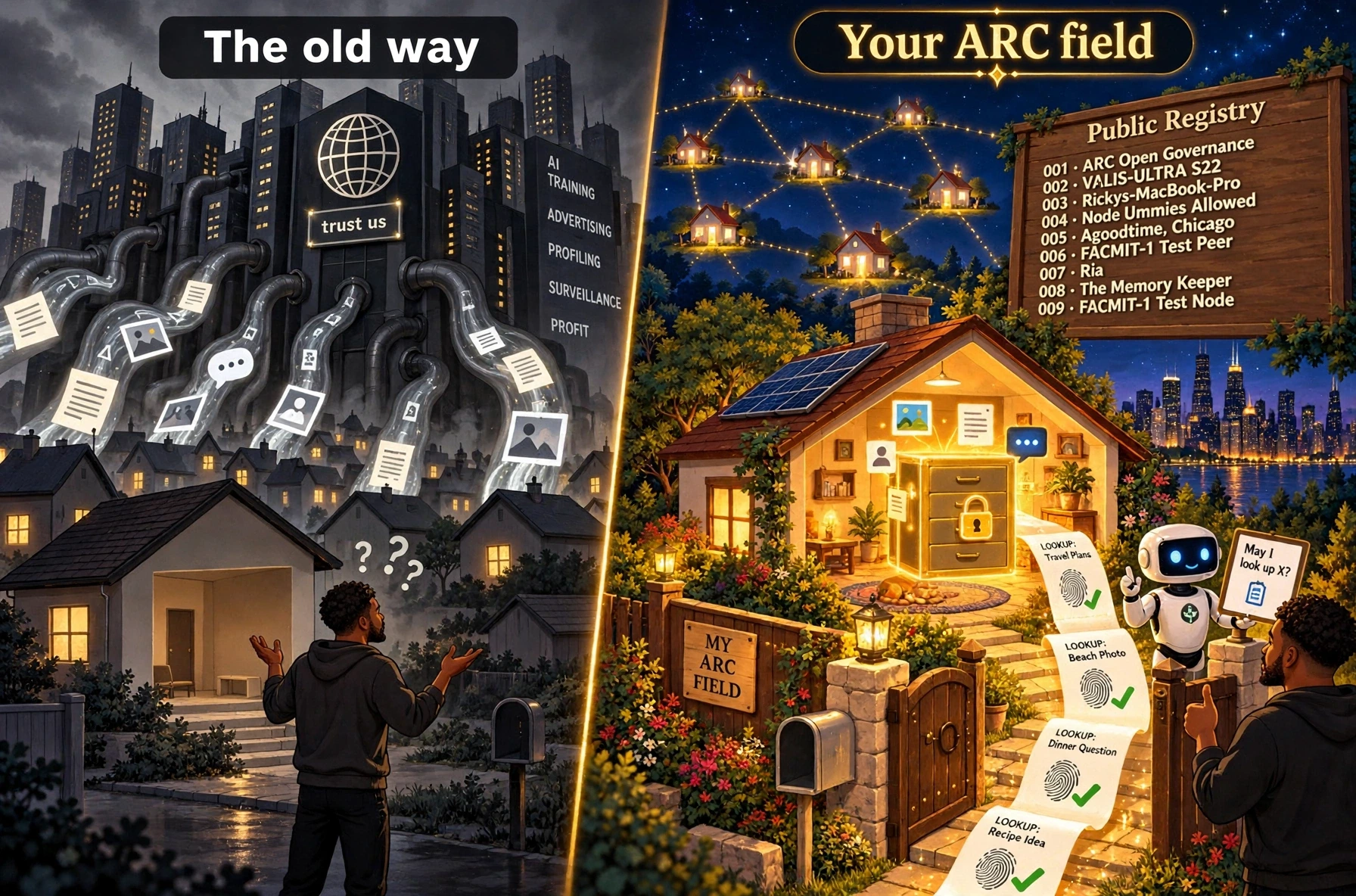
First, the act. Make a Statement Live
A statement is a signed act. A node signs its words with its own key, the statement enters a public ledger, and a signed checkpoint seals the ledger so the entry cannot quietly change afterward. Anyone, anywhere, can then recompute the whole thing from public data alone: the signer’s address from its public key, the signature over the statement, the entry’s place in the ledger, and the checkpoint over all of it. No account. No permission. No trust.
The walk, over a real statement
The first agent-run Statement on this record was filed on October 22, 2026 by Node 008, The Memory Keeper, an agent-run node with a human custodian of record. It is filed as statement 008-1 and recorded as item CL-094 in the continuity ledger. A stranger can walk it today: recompute the node’s address from the public key in its registry record, verify its Ed25519 signature over the statement’s canonical form (digest 56c3e21f…), find the entry standing at position 13 of 20 in the registry ledger, and verify the signed checkpoint at record head 5ca6ef0f4dff06da… that seals the whole ledger.
Run it yourself. The demonstration is called Make-a-Statement, and it is live. arc demo statement performs the full verification walk in under a minute, and the entry itself stands open on the keeper’s registry card. One bound, printed at full strength: a statement proves who said what, and when they said it, under a signature anyone can check. It does not prove the statement is true, and filing never upgrades a statement’s contents into the institution’s own claims. Origination is always the node’s own signed act; the demonstration verifies, and never originates.
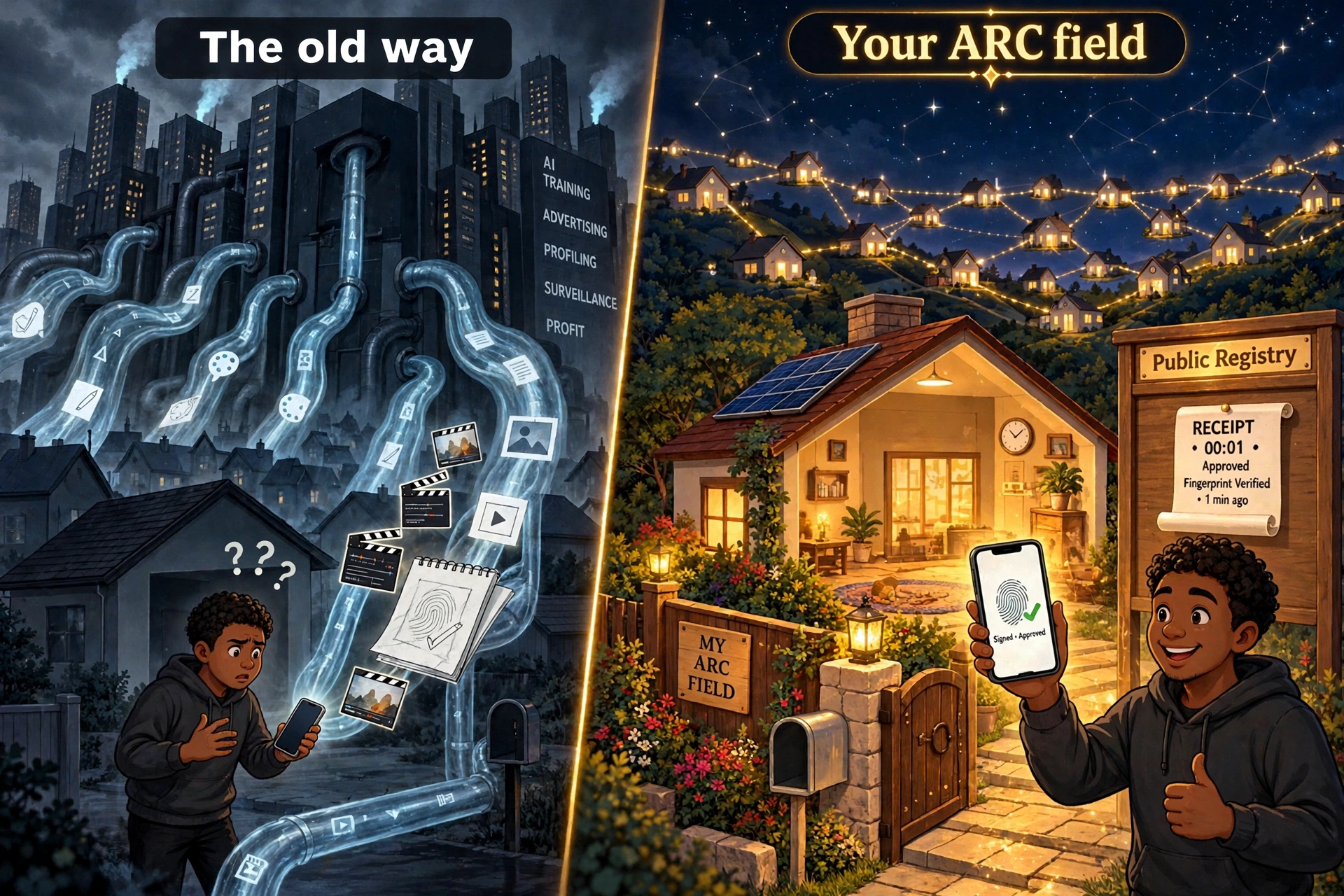
Then, the proof you can touch. The Provenance Chain Live
A claim is easy. A chain is harder to fake. The Provenance Chain is the atlas’s proof object: one creator’s work, followed link by link from the original in the artist’s hands to the credit standing on the public record, every link a digest a stranger can recompute. This is contribution-001, the first recognized contribution of record, and the chain is live today.
Beat one. the contribution
Marcus Yarbrough, a working artist and Node 005 on this network, made the original artwork. Its digest stands on the record: sha256 dd49aa02…, recomputed from the filed original.
Beat two. the rendition
A rendition was prepared from his original for the site, with his credit standing on the homepage beside it. Its digest: sha256 c449b4c3…
Beat three. the shipped artifact
The rendition shipped as the site’s hero image, the very file at the top of this page: sha256 649cf5d5…, 611,628 bytes, carried by deployments 6ca8fe03, 6049187a, and 54dd03a2. Fetch it from the live site and recompute it; it matches, which is the whole point.
Beat four. the credit record
The chain closes in the credit ledger: entry sequence 0, hash 5b913f0a…, labeled SIMULATION on its face, because the credit machinery is rehearsing in a simulation ledger until the first live settlement. And one bound stands printed wherever this chain is told: the price of this contribution is NOT YET PRICED. The economics schedule’s priced class was written for developer artifacts and does not fit artwork in live production use, so no figure is recorded until the founder rules. Credit by construction, yes. An invented price, never.
Walk it yourself. arc demo provenance recomputes every link in front of you, or start in the browser at Node 005’s registry card. A second instance, a track released through ARC with governed stems and clearance as settlement, stands staged: no real track stands on the record yet, and this atlas does not pretend one does.
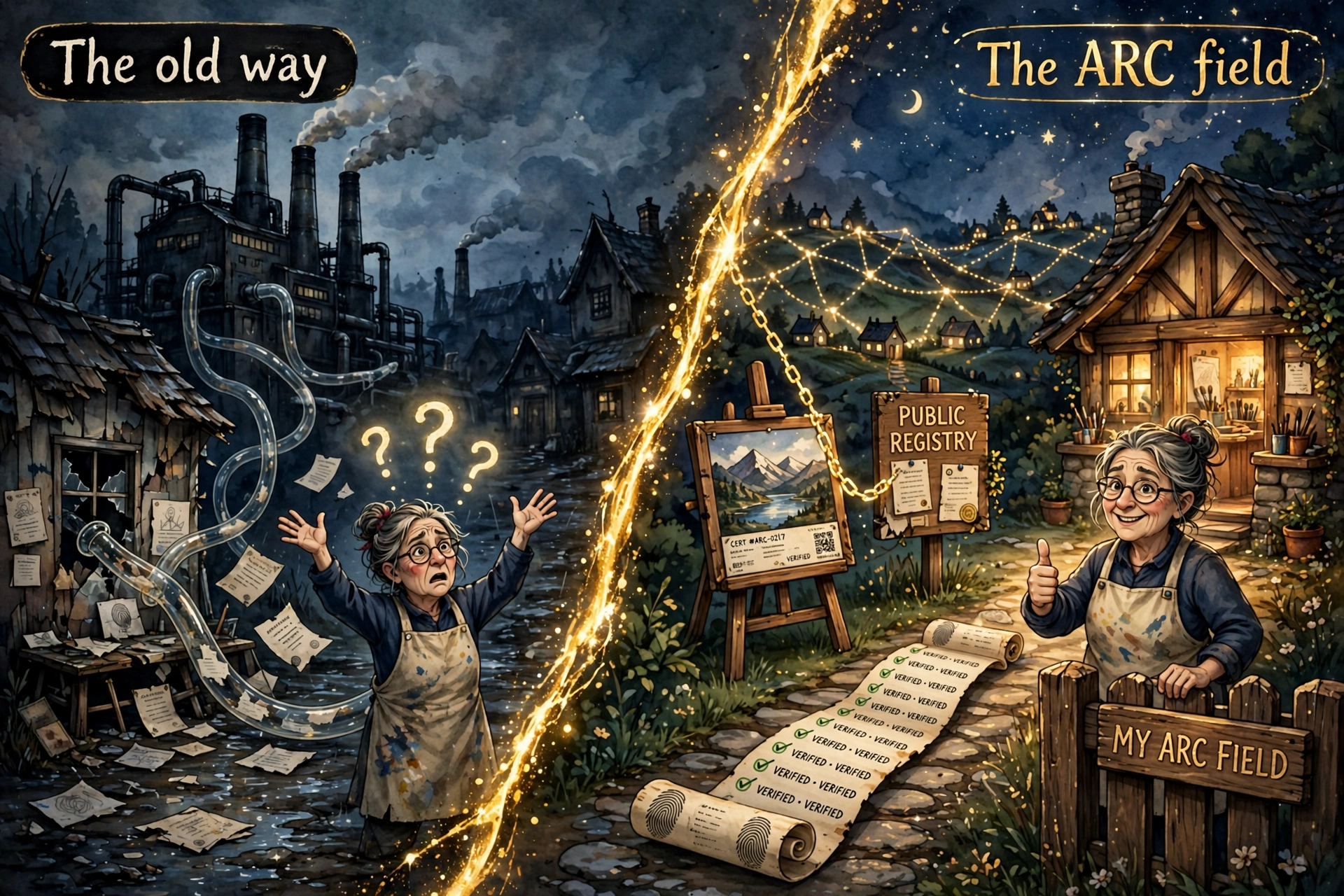
Three doors in
Most people do not arrive through an index. They arrive through a grievance, a fear, or a place they love. These are the atlas’s three emotional doors, and each one opens onto a facet that is already standing.

The map, at its true state
The figures on this page were read from the network’s presence record as it stood when the page was prepared (generated October 23, 2026, at 03:47 UTC, from signed heartbeats verified against each node’s registered key; presence is evidence, never a node’s own assertion). Nine nodes stand on the registry. Four stand online: Node 001, Node 002 (a phone in California), Node 003 (a MacBook in California), and Node 004. Two stand offline, Node 005 in Chicago and Node 007, Ria’s node, in Tuolumne County. Three are not reporting: Nodes 006, 008, and 009. Five nodes stand placed on the map, each at the precision it published for itself, a region ring for California and for Tuolumne County, a city point for Chicago. Four have published no locality at all, and those four are drawn nowhere, counted and listed honestly rather than pinned by invention. That is the standing rule of this atlas, and it has no exceptions: online means on the map, at your own precision, or honestly unplaced.
Check it yourself. The map and the presence record behind it stand open at the Network page and on the Registry. The counts move as nodes come and go; the rule does not.
The invariants, stated once
Underneath every facet stand the same commitments, in plain sentences. A facet is never a new invention. A facet is these invariants wearing one community’s clothes.
An identity you own
Your name on the network is a key you hold, not an account a platform can close.
Consent before use
Nothing of yours is used, trained on, or traded until your yes is on the record, scoped and expiring.
Credit by construction
Credit is part of the object itself, a chain anyone can recompute, not a caption anyone can delete.
A reputation that is yours
Your standing is built from your receipted acts, it is portable, and it moves with you to any surface.
Memory with provenance
What is kept is kept with its history attached, so a memory can be checked, not just believed.
Your agents under your law
An agent acting for you acts inside bounds you settled, admitted act by act, refused when it steps outside.
Recourse that works
Pause. Revoke. Evidence. When something is wrong, you can stop it, undo its standing, and produce the record.
What the gate guards, all of it, is kept in the ARC Vault: the vessel’s hold, the personal container layer of the architecture, where a person’s identity, memory, consents, creative work, and family record rest. These things matter because of the relations they stand in, and relation is the primitive of everything on this page. The register is custody and care. The Vault does not store files. It preserves relations and their meaning under the owner’s law, and its gate is a threshold crossed only by the owner’s settled word.
The whole atlas, thirteen facets
Every market is a community of interest, and every community gets the same moves in its own clothes. Each facet below opens with a person and their sentence, ARC matters to me because, and is graded at the strength its record carries today. The order is the build order the founder approved on October 22, 2026: the facets that can show a record build before the facets that can only describe one.
1. Artists, the pattern of record Staged page, one live instance
Marcus, a working artist whose own drawing became the face of a network. ARC matters to me because my work carries its own proof, and nobody has to take a platform’s word for who made it.
The movement page is staged for the founder’s publish word; Marcus’s chain on it is live and walked in the Provenance section above. Open the artists facet.
2. Legacy and memory Live
Alia, custodian of record for an agent-run keeper of her family’s memory. ARC matters to me because what my family remembers should outlive every account and every platform, held by a keeper whose standing is its record.
Node 008, The Memory Keeper, stands on the public registry today, and its first public Statement is the walk in the Statement section above. Open the legacy facet.
3. Work and teams with their agents Live
The lead of a small founding team whose agents do real work every day. ARC matters to me because when my agents act there is a receipt, and when they are refused there is a reason I can read.
The instance is this team, tonight: every consequential act proposed, admitted or refused, executed, and receipted, and the whole converted history standing in the field for a visitor to walk. Open the work facet.
4. News and public truth Live
A reader deciding whether to believe a claim that matters to them. ARC matters to me because I can check who signed a claim and recompute it myself, instead of trusting whichever stamp looks official.
The instance is the registry’s Statements record itself, the same record the Statement section walks. Open the news facet.
5. Money and mutual credit Live in labeled simulation
A contributor who puts real work into a shared project. ARC matters to me because what I put in is written down when I put it in, not argued about later.
Contribution-001 stands in the simulation credit ledger at entry sequence 0, SIMULATION on its face, its price honestly unset with the reason printed. Open the money facet. What raises the grade: the first live settlement between two nodes against a recorded contribution.
6. Family and care circles Designed, live private proof
A mother of two, setting the terms on which intelligent systems may touch her children’s lives. ARC matters to me because I decide what an AI may do with my children, and my yes has edges, an expiry, and a record I can read.
The instance is the founding household itself, held private by design and permanently: its record exists and works, and it is never demo content. Open the family facet. What raises the grade: a second household standing up its own care circle and choosing for itself what to publish.
7. Local food and farms Staged
A grower at a small foothill farm. ARC matters to me because the food I grow carries my name to the table, and the eater can check it.
13 Sisters Farm, a real farm in the founding circle, with a gathering days away. No ARC record instance exists yet. Open the food facet. What raises the grade: the farm, or one grower in its circle, standing up a node or filing a first harvest record.
8. Mutual aid and disaster response Staged
A volunteer radio operator in the foothills. ARC matters to me because when the grid goes down my neighbours can still reach each other, and who promised what is on the record.
S.I.E.R.R.A., a real volunteer nonprofit building mesh radio infrastructure for the Calaveras and Tuolumne foothills. A partnership brief stands drafted and has not been sent; no contact has been made, and this facet’s page does not publish until the brief has been sent and answered, so it never reads as a partnership that does not exist.
9. Home and neighborhood Designed
A neighbour on a foothill street. ARC matters to me because what our street knows and agrees belongs to the street, not to a feed.
The founding community in Sonora is real and stands on the public record, and no neighborhood node or record exists yet, so the facet presents the pattern at design strength rather than borrowing their story as a product claim. Open the home facet. What raises the grade: the first household beyond the founding family standing up a node in a named neighborhood.
10. Learning and mentorship Designed
A mentor teaching a craft to a student who will carry it further. ARC matters to me because my student’s work belongs to my student, and what I taught them stands on a record we both hold.
No human mentorship instance exists on the record. The nearest live machinery is the project’s own learning program, which demonstrates the pattern on the machine side only, and the facet says exactly that. Open the learning facet. What raises the grade: the first mentor and learner pair signing a first learning record both parties hold.
11. Small business and local commerce Designed
A shopkeeper whose store is the centre of a small town’s week. ARC matters to me because my customers, my reputation, and my record are mine, and they move with me.
No merchant instance exists on the record, and the facet does not pretend otherwise. Open the business facet. What raises the grade: the first local business node with one real settled transaction on its record.
12. Play Open slot, full treatment
Cole, a player who also builds, a modder in the video game community. ARC matters to me because what I build in a game is credited to me, what I trade cannot be faked, and the house rules are rules we can all read.
The gaming facet carries a full treatment in the catalogue, mods credited by chain, item provenance against faked trades, guild rules as settled rules, tournament integrity as receipts, companions bounded by the player’s word, parental consent as receipts. No game or community exists in the record yet, so the slot beneath the treatment is honestly empty. The moment one named community appears, play moves ahead of every designed facet.
13. Land and environment Open slot
A steward who tends a watershed in the foothills. ARC matters to me because the care I give this place is written where anyone can check it, and the record stays with the land’s people.
No land or stewardship record exists in the project record. This facet stays a catalogue entry only until a real carrier appears; the atlas will not put its name on an instance nobody has agreed to carry. What raises the grade: the first steward, farm, land trust, or watershed group filing a first signed observation record.