The Relational Atlas · Facet nine · Home and neighborhood
What our street knows belongs to our street.
A neighbour on a foothill street puts it in one sentence: ARC matters to me because what our street knows and agrees belongs to the street, not to a feed. This page is that sentence, worked as a pattern. It leads with the human sentences, because they are the point: what our street knows belongs to our street, and the map lights up because people stood up. The machinery is named second, underneath, where it belongs: neighbours holding nodes, what the street knows standing on a record the street itself can read, and a community's memory that survives any one platform's decisions.
One thing stands in front of all of it, and this page prints it before anything else can be mistaken. This facet presents a pattern at design strength, and it claims no instance. A real founding community stands behind this project, and section three names it at exactly the strength the public record carries. But no neighborhood node and no neighborhood record exists, and this page does not borrow the founding community's story as a product claim. Section three states that refusal plainly, and the whole page obeys it.
Who can help, on the record
The ladder, the truck, the spare room, the steady hand with a fence or a roof, recorded by the street itself, so help starts from knowledge instead of from whoever happens to be scrolling.
Agreements the street can read
What was settled about the shared fence, the quiet hours, the borrowed things, written down and signed by the households it binds, readable by the street that made it.
Help inside each household's bounds
Agents help within the bounds each household set for itself, and no further. A household's yes has edges, and the edges are part of the record.
A memory no platform can delete
The street's history, its agreements, its people, its seasons, kept on a record the community holds, so it survives any one platform's decisions about what stays up.
Pause, revoke, prove it
An offer can be paused, a permission revoked, and the evidence for either produced on demand. Recourse is a settled act on the record, not an appeal into a feed.
One. the old way, the feed's street
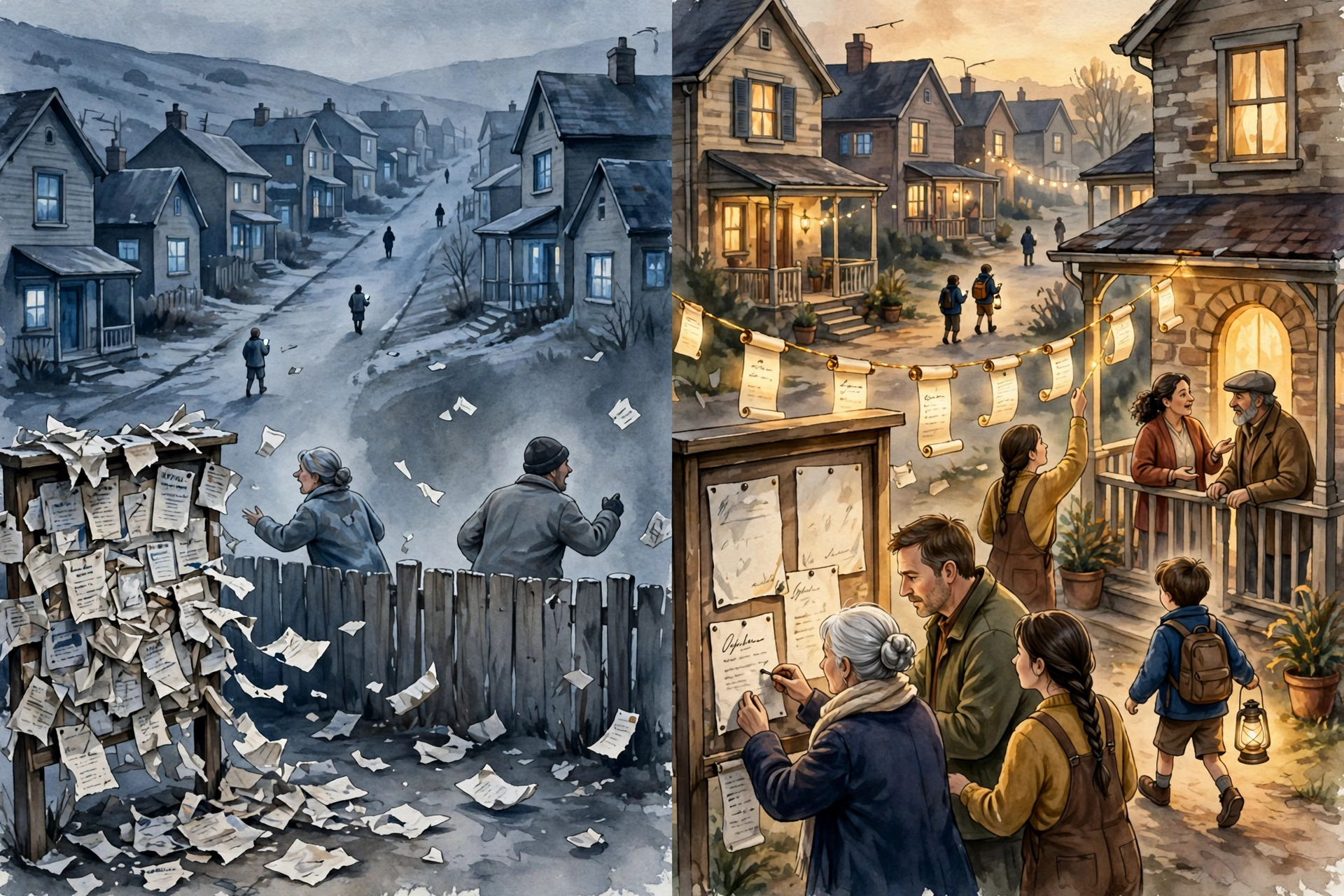
Start where the street actually keeps its knowledge today. It lives in feeds, ranked for engagement, which means ranked for everything except usefulness to the street. Who can help sits buried under whatever is louder. Who needs help is visible only while the post is fresh, and then it sinks. What was agreed about the shared fence, the parking, the quiet hours, was settled in a thread that scrolled away months ago, and the settlement is whatever the angriest screenshot says it was. The record of the street belongs to the platform, kept in the platform's format, under the platform's decisions, and when the platform changes its terms or folds its product, the street's memory goes with it.
None of that is because neighbours failed to write things down. They write constantly. They write into a container that was never theirs, ranked by rules that were never about them, in a place none of them can carry away. The knowledge a street holds about itself is some of the most valuable knowledge in a community's life, who is trustworthy, who is struggling, what was promised and what was kept. In the old way all of it accrues to somebody else's record. This facet is the other answer, worked move by move.
Two. the pattern, worked move by move Designed
Four moves, each worked the same way: what the old way does with it, what the relational way does instead, and the invariant underneath that carries it. The invariants are the atlas's own, stated once for every facet. An identity you own. Consent before use. Credit by construction. A reputation that is yours and portable. Memory with provenance. Your agents acting under your law. And recourse that works: pause, revoke, evidence.
Move one. local knowledge on a record the street can read
The old way lets the feed decide what the street knows. A post about a lost dog, a spare ladder, a warning about a washed-out road competes with everything on earth for the same ranking, and it loses to whatever is louder. The relational way puts the street's knowledge on the street's own record. Neighbours hold nodes. Who can help, who needs help, what stands offered and what stands needed stand as entries on a record the street itself can read, ordered by the street's own concerns rather than by an engagement ranking, and kept where the people it describes can find it next month and next year.
Where this move stands. The invariants underneath are memory with provenance, and a reputation that is yours and portable. The node machinery this move draws on is live at full strength elsewhere in this atlas: nine nodes stand registered on the public record, each holding its own identity, and the registry and the presence record are walkable by a stranger today. The neighborhood layer itself is not built. No street holds a knowledge record of this kind, no household has listed a ladder or a spare room on one, and this page grades the move at the facet's own grade: designed.
Move two. offers and agreements stand as statements
The old way loses settlements. The fence agreement, the quiet hours, the borrowed trailer, the promise to keep an eye on a house during a trip, all of it lives in threads that scroll away, and a disagreement afterward is two memories arguing. The relational way makes each one a statement: signed by the households it binds, filed on the record the street holds, and readable back word for word beside the occasion it was made for. An offer of help is an object the record holds, not a comment under a post. It is the atlas's lead act at the scale of a street: Make a Statement, where a statement is a thing a neighborhood can be run on.
Where this move stands. The invariants underneath are consent before use, and credit by construction. The statement machinery is live and walked in facet four of this atlas, where a reader recomputes a filed Statement rather than trusting a stamp, and the demos shelf walks it end to end. No neighborhood agreement and no neighborly offer has ever been filed on it. The filing of the first one belongs to a real street to make, and this page grades the move as designed.
Move three. agents help within the bounds each household set
The old way gives a platform's assistant the whole household at once, under terms the platform wrote, changeable at the platform's word. What it may arrange, whom it may contact, what it may spend or promise is a settings page, if it is anything. The relational way draws the bounds household by household. An agent helping on the street acts inside the bounds each household settled for itself: it can carry a request to the neighbours a household named, offer only what that household offered, and stop at the edge of the yes it was given. The bounds are part of the record, readable by the household that set them, and a refusal at the boundary is a receipt, not a mystery.
Where this move stands. The invariants underneath are your agents acting under your law, and recourse that works. Governed agents are live machinery on this network's own operation, where every consequential act is admitted or refused with a reason a person can read, and facet three of this atlas shows that record, refusals and all. A household's neighborhood bounds are the designed form of that machinery wearing a street's clothes. No household has set them, and this page will not pretend one has.
Move four. a community memory that survives its platforms
The old way makes a street's memory a tenancy. The group's archive, its photographs, its decisions, its list of who did what and when, sits inside a product that can be sold, shut down, or repriced, and a neighborhood that changes platforms starts its memory over from nothing. The relational way keeps the memory with the community. The street's record is held by its nodes, in a form the street can carry to any surface, so a platform's decision about its own future is not a decision about the neighborhood's past. What the street agreed, celebrated, repaired, and mourned stays readable by the people it belongs to for as long as they choose to keep it.
Where this move stands. The invariants underneath are memory with provenance, and an identity you own. Memory kept this way is live at full strength in facet two of this atlas, where an agent-run keeper holds a family's record across time under a custodian of record, and a stranger can walk its standing. No street's memory stands on that machinery, and no community archive of any neighborhood exists on this record. The move is the pattern, at the facet's grade: designed.
What the street holds, underneath all four
Every record above has to live somewhere, under somebody's law. In this architecture it lives in the Vault. ARC is the architecture; the ARC Vault is the vessel's hold, the container layer where a record is kept. A street's hold would carry its shared record: its agreements and their history, who holds what for whom, the tools and rooms and skills its households offered each other, and the standing of the people who kept their word, preserved as relations and their meaning under the street's own law, not as content in a platform's neighborhood product. The Vault does not store files. It preserves relations and their meaning under the owner's law, and its gate is a threshold crossed only by the owner's settled word. What the platform era kept in systems a street could not carry away, the street keeps in its own hold.
Where this stands. The Vault naming is staged for the founder's approval like all brand language in this program, and the street record's place inside it is stated here as the pattern specifies it. The container layer exists in the application today as Your Vault. A street's shared record carried in it at the depth this page describes is the design this facet exists to state.
Three. the foundation, and what this page will not borrow
This facet is designed rather than staged because its pattern is fully specified and its foundation is real, and honest about the distance between the two. The founding community in Sonora is real and carried this project through its founding season, Renée Orth's home, community, and connections, and Ann Fox Morgan's support across almost four years, and both stand on the public record as founding members of ARC Open Governance. That is the catalogue's own sentence for this facet, and this page prints it at exactly that strength and no warmer.
Here is the refusal, printed as plainly as the foundation. That record stands in its own place, on the foundation's own pages, as a matter of gratitude and governance. This facet does not convert it into a neighborhood deployment, because no deployment happened. It does not convert it into an endorsement of a product, because none was given for this purpose. It does not use it as demo content, because their support was given to a founding season, not to a sales page. No neighborhood node exists. No neighborhood record exists. No street has been onboarded, mapped, or organized by this project anywhere, and anyone reading this page should come away knowing exactly that.
What raises this facet is the same act the catalogue names, and it belongs to people who have not yet appeared: the first household beyond the founding family standing up a node in a named neighborhood, publishing at its own chosen precision. That household will choose its street, its precision, and what of its record to make public, the way every node on this network has chosen for itself. When it happens, this page's pattern becomes an instance and the grade rises on the strength of the record, not a day before.
The map today, and the door this facet opens
The nodes-lighting-up wedge is this facet's natural door, because the pattern it describes is the map's pattern at household scale: a place lights up because the people in it stood up, one node at a time, at precisions they chose. The live map stands behind that door today. As the registry presence record stood at its generation on October 22, 2026, at 9:04 PM Pacific, nine nodes stood registered on the network. Four stood online, Nodes 001, 002, 003, and 004. Two stood offline, Nodes 005 and 007. Three stood not reporting, Nodes 006, 008, and 009. Five of the nine have published a locality and stand placed on the map at their own chosen precision, two as a California region, one as a further California region, one as Chicago, and one as Tuolumne County. The other four have published no locality and stand honestly unplaced, counted and listed, drawn nowhere. The network page carries the map itself, at the presence record's own freshness.
Where this stands. Every figure above is the founding network's, read from the registry presence record at the time named, and none of the nine is a neighborhood node. The map lighting up street by street, household by household, is the pattern this facet exists to describe, and it has not begun. The first household that begins it raises this facet, and the map will show it at that household's own precision when it does.
Where this facet stands. DESIGNED. The pattern is fully specified: neighbours holding nodes, a street's knowledge and agreements on a record the street can read, agents inside each household's bounds, and a memory that survives its platforms. The foundation underneath it is real and stands on the public record in its own place. No instance is claimed, no story is borrowed, and no household's arrangements are used. The raising act is named above, and it belongs to a household that has not yet stepped forward.
The extent, in one visit
Facet nine of the Relational Atlas. Facet six showed consent with edges at the kitchen table. Facet eight showed the same invariants in the worst week of a place's year. This facet shows them at the scale of an ordinary street on an ordinary evening: who can help and who needs help, what was agreed and whether it was kept, all of it standing on a record the street itself holds, under the street's own law, readable by the people it is about. Its foundation is real, its pattern is ready, and its first instance belongs, honestly and entirely, to a household that has not yet stood up.
What our street knows belongs to our street. The map lights up because people stood up.