The Relational Atlas · Facet seven · Local food and farms
Your food. Your farm. Your terms.
A grower at a small foothill farm puts it in one sentence: ARC matters to me because the food I grow carries my name to the table, and the eater can check it. This page is that sentence, cashed. It leads with the human sentences, because they are the point: your food, your farm, your terms, and knowing whose hands fed you. The machinery is named second, underneath, where it belongs: provenance that starts in the field, terms that travel with the harvest, and a chain any eater can walk.
One thing stands in front of all of it. This facet’s instance has not happened yet. A real farm stands in the founding circle, a real invitation stands on the record, and no ARC record of any farm exists tonight. Section three states that standing plainly, and the whole page obeys it.
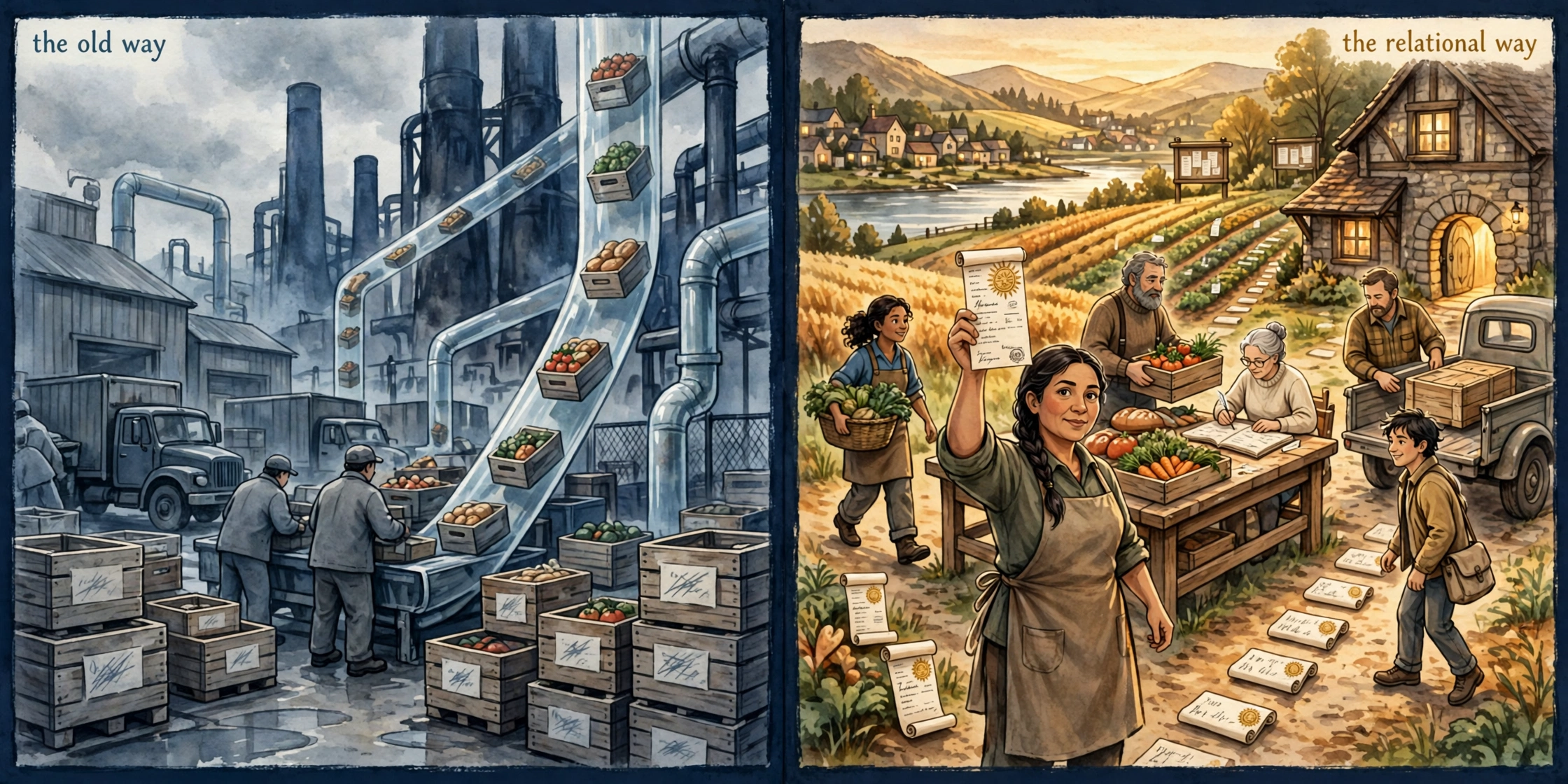
The name travels
Food leaves the farm carrying the grower’s name, the field it came from, and the hands that harvested it. The name is part of the record, not a label a distributor can replace.
Provenance by construction
Each step from field to table is receipted as it happens, so the chain is built by the work itself. Nobody has to reconstruct it afterward from a story on a package.
Terms that travel
The grower’s terms move with the food: how it may be sold, how it may be described, and what the farm’s share is. A buyer takes the food on those terms, or not at all.
Credit lands on the hands
Harvest work is credited to the people who did it, on the record, at the time they did it. Credit is computed from the record, not argued about when settlement comes.
Pause, revoke, prove it
A grower can pause a listing, revoke a permission, and produce the evidence for either, and each act stands on the record beside the act it answers. Recourse is a settled act, not a support ticket.
One. the old way, from the field gate
Start where the food actually starts. A grower spends a season bringing a crop in, and at the field gate the crop stops being hers in every way the world can see. A distributor’s label replaces the grower’s name. The eater at the far end cannot check where anything came from, whose hands picked it, or what was done to it on the way, because the chain between the field and the table is a series of private hands, each keeping its own counsel. The farm’s share of the final price is set by everyone except the farm, in rooms the farm is not in. And the story that reaches the table, local, family grown, honestly raised, is a story printed on a label, which is to say a claim nobody can check and nobody has to prove.
None of that is a technology limit. It is a choice about whose name food travels under, and whose record it answers to. The old way answers that the chain decides. This facet is the other answer, worked move by move.
Two. the pattern, worked move by move Staged
Four moves, each worked the same way: what the old way does with it, what the relational way does instead, and the invariant underneath that carries it. The invariants are the atlas’s own, stated once for every facet. An identity you own. Consent before use. Credit by construction. A reputation that is yours and portable. Memory with provenance. Your agents acting under your law. And recourse that works: pause, revoke, evidence.
Move one. provenance that starts in the field
The old way begins the record at the packing shed, if it begins one at all, and everything before the shed is the grower’s word against the world’s indifference. The relational way begins the record in the field. The planting, the tending, and the harvest are statements on the farm’s own record, signed as they happen, and each hand the food passes through adds its own receipt to the same chain. Provenance is not a biography written afterward to decorate a label. It is the chain itself, built by construction out of the acts that moved the food, and it can be recomputed by anyone the chain is shown to.
Where this move stands. The invariants underneath are memory with provenance, and credit by construction. The chain machinery is live elsewhere in this atlas at full strength: a work of art already travels with exactly such a chain, contribution-001 in facet one, and the Provenance Chain walk on the demos shelf lets a stranger recompute it link by link. A harvest chain carried the same way is the pattern this facet specifies. No harvest record exists yet, and this page grades the move at the facet’s own grade: staged.
Move two. the grower’s terms travel with the food
The old way separates the food from the grower’s say in it at the first hand-off. From that moment the distributor’s terms, the retailer’s terms, and the platform’s terms govern, and the grower’s terms are a conversation nobody recorded. The relational way keeps the terms attached. The food moves carrying the conditions its grower set: the name it is sold under, the claims that may be made for it, the share that returns to the farm, and the uses that were never granted. A buyer who takes the food takes it on those terms, settled before the fact and readable afterward, because the terms are part of the record the food travels with, not a promise made beside it.
Where this move stands. The invariant underneath is consent before use. Terms traveling with the object they govern is the same pattern facet one works for creative work, where a work carries its own record and use is settled before it happens. Drawn here for food at the same pattern strength, inside a staged facet: no distributor or buyer holds a farm’s terms this way yet, and this page will not pretend one does.
Move three. buyers and members in receipted relation to a named farm
The old way makes eaters anonymous twice over. The farm never learns who its food fed, and the eater never stands in any relation to the farm that a season could build on. A CSA box or a market stall, in that world, is a transaction that forgets itself. The relational way lets the relation be the record. A member joins a named farm’s season under settled terms both sides can read. Each delivery is receipted against that relation, so the member’s support and the farm’s harvest stand on one record, season over season. The farm’s reputation is its own, built from receipted deliveries, and portable, because it lives on the farm’s record rather than inside a platform that could hold it hostage.
Where this move stands. The invariants underneath are an identity you own, and a reputation that is yours and portable. The node machinery a farm would stand on is live tonight: nine nodes stand registered on the public record, each holding its own identity. None of the nine is a farm. A farm node, stood up by the farm itself, is the act that turns this move from pattern into instance.
Move four. a chain the eater can check
The old way asks the eater to trust the label, and the label answers to marketing. Miles traveled, hands it passed through, cold rooms and hot trucks: all of it asserted, none of it checkable, and a correction, when one comes, never catches the claim it corrects. The relational way hands the eater the chain itself. How far the food traveled and through whose hands is not a story about the record; it is the record, each leg signed by the party that carried it. And the door into that record is the atlas’s lead act: the farm publishes its harvest as statements, signed and filed in the open, Make a Statement in the plainest sense, so the claim an eater reads at the table is the same object the farm signed at the field.
Where this move stands. The invariants underneath are provenance anyone can check, and recourse that works. The statement machinery is live and walked in facet four of this atlas, where a reader recomputes a filed Statement rather than trusting a stamp. The harvest statement that would let an eater do the same for a meal does not exist yet. It is one signed act away, and it belongs to a grower to make.
What the farm holds, underneath all four
Every record above has to live somewhere, under somebody’s law. In this architecture it lives in the Vault. ARC is the architecture; the ARC Vault is the vessel’s hold, the personal container where identity, memory, consents, and creative work are kept. A farm’s hold would carry its seed and soil history, its seasons of harvest records, its member relations, and its terms, preserved as relations and their meaning under the grower’s law, not as files in a platform’s cabinet. The Vault does not store files. It preserves relations and their meaning under the owner’s law, and its gate is a threshold crossed only by the owner’s settled word. What the platform era kept scattered across distributors and marketplaces, unanswerable and unowned, the farm keeps in its own hold, readable by the people it belongs to.
Where this stands. The Vault naming is staged for the founder’s approval like all brand language in this program, and the farm record’s place inside it is stated here as the pattern specifies it. The container layer exists in the application today as Your Vault. A farm’s record carried in it at the depth this page describes is the design this facet exists to state.
Three. the connection, stated plainly
This facet is staged rather than designed because its carrier is not hypothetical. 13 Sisters Farm is a real farm in the founding circle. On October 16, 2026, Allpa, of that circle, texted Alia Dixon inviting her and Ricky to a gathering at the farm on Saturday, October 24, 2026. Ricky confirmed the next day that he has handled that thread himself. The connection is real, it is current, and a gathering days away stands at the end of it.
That is the whole of the farm’s standing in this atlas today, and this page prints no more than that. The invitation was extended to two people, not to a network. The farm has filed nothing, endorsed nothing, and runs nothing of ARC’s, and nobody should read this page as claiming otherwise. What the connection makes true is narrower, and worth having: when the conversation about a farm node or a first harvest record happens, it will happen between people who already know each other, across a table that already exists.
What raises this facet is printed in the catalogue and stands unchanged: the farm, or one grower in its circle, standing up a node or filing a first harvest record. Until one of those acts happens, the grade stays staged, however warm the connection. A grade rises only when the record rises.
Where this facet stands. STAGED. The page and the pattern are built; a real connection stands behind them; the instance itself, a farm’s own record on ARC, has not happened yet. Nothing in this section is taken from any private message beyond the invitation’s existence, its date, and its gathering, which the filed catalogue itself carries.
Nine nodes stand registered on the public record, and none of the nine is a farm.
The extent, in one visit
Facet seven of the Relational Atlas. Facet one showed a work of art carrying its own proof. Facet six showed consent worked at the kitchen table. This facet shows the same invariants at the field gate: food that carries its grower’s name, a chain built by the hands that moved it, terms that travel with the harvest, and eaters who can check the whole of it themselves. Its carrier is a real farm and a real invitation, and its record, honestly, has not begun. The pattern is ready for the day it does.
Your food. Your farm. Your terms.